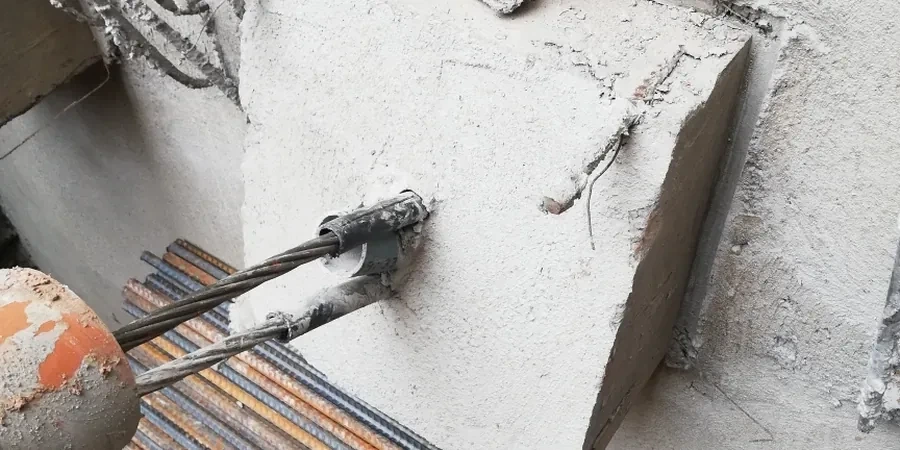
Newcastle's transition from a heavy-industrial port to a modern coastal city has reshaped its underground. The old rail corridors and reclaimed harbour land sit on fill that looks solid on top but hides compressible layers underneath, while the hill suburbs cut straight into weathered Newcastle Coal Measures. We see it constantly during site investigations: a project on Hunter Street hits old ballast and slag, while a job in Merewether climbs into fractured tuff and claystone. Designing an anchor system here means reading the ground before you tension a single strand. The choice between active anchors, which apply pre-load to control movement from the start, and passive anchors, which engage only when the soil deforms, depends entirely on how that particular Newcastle profile will behave under load. Combining the CPT test with borehole data often gives us the continuous stratigraphy needed to decide between a restrained basement excavation in the CBD and a fully tensioned tieback system on a sloping site near Bar Beach.
An anchor is not a tensioned bar; it is a complete interface system that transfers load from a structural facing into stable ground, and its performance depends entirely on the bond zone geology.
Scope of work
AS 4678:2002 governs earth-retaining structures in Australia, and it leaves little room for guesswork when you are working in Newcastle's variable geology. The standard demands that anchor design account for groundwater, aggressive soil chemistry, and long-term creep, all of which matter here. The coal seams and interbedded siltstones that run through the Newcastle region can be acidic, so we specify double-corrosion protection as a baseline, not an upgrade. Active anchors are normally proof-tested to 1.25 times the design load and locked off at a set pre-stress, which is critical when you are restraining a shoring wall next to an existing terrace in Cooks Hill. Passive rock bolts and soil nails, on the other hand, rely on ground deformation to mobilise capacity; they work well in the competent sandstone benches found below 4 to 5 metres in many parts of the city. For a typical project we define the bond length, the unbonded length, and the encapsulation method — gravity fill or pressure grouting — based on direct shear test results from the site, not from generic tables. The
slope stability analysis feeds directly into anchor spacing and inclination, especially on the steep blocks overlooking the harbour where even a small excavation can trigger a larger failure surface.
Area-specific notes
The most common mistake we observe in Newcastle is treating an anchor specification as a catalogue item: ordering '15-metre tiebacks' without investigating what those 15 metres are bonded into. We have seen projects where anchors were installed into saturated fill behind an old quay wall, with the fixed length terminating just inside the same fill, not in competent rock. The result is a system that loses pre-stress within weeks as the bond zone consolidates under tension. Another recurring problem is underestimating the effect of coal seam dip on anchor capacity: a borehole that shows sandstone at 6 metres on one side of a Lambton site can hit coal at the same depth 20 metres away, completely changing the required bond length. Corrosion is not a theoretical risk here; the combination of salt-laden coastal air, acid-sulphate soils in low-lying suburbs, and stray currents from the old rail and tram network infrastructure means a poorly protected anchor can fail silently underground. Our role is to specify anchor type, bond length, free length, and protection class so the system does not become the weak link in a retaining structure that was otherwise well designed.
FAQ
What is the difference between an active and a passive anchor?
An active anchor is tensioned after installation to apply a known pre-load to the structure, which limits ground movement from the outset. A passive anchor is not pre-stressed; it develops resistance only when the ground deforms enough to mobilise tension in the steel. Active anchors are preferred for sensitive structures where settlement or lateral movement must be minimised, while passive anchors work well in stable rock cuts where some small deformation is acceptable.
How long does anchor testing take on a Newcastle site?
A suitability test on a sacrificial anchor typically runs for 24 to 72 hours, including extended creep monitoring at the maximum test load. Production anchor acceptance tests are shorter, usually 15 to 30 minutes per anchor, depending on the load steps and stabilisation criteria defined in the project specification. We schedule testing to keep the excavation and construction sequence moving without delays.
Do Newcastle's coal seams cause problems for ground anchors?
Coal seams can present challenges because they are weaker and more compressible than the surrounding sandstone and siltstone. If a bond zone is placed within a coal seam or too close to its interface, the ultimate bond stress will be lower and creep may be higher. We map the coal seams during the site investigation and adjust the anchor length and inclination to position the fixed anchor in competent rock, away from seam boundaries.
What corrosion protection is required for permanent anchors near the coast?
For permanent anchors within 5 kilometres of the Newcastle coastline, we specify Class I corrosion protection as a minimum under AS 4678. This means a double barrier system: the steel tendon is encapsulated in corrugated plastic sheathing filled with cement grout, and the entire assembly is further protected by a surrounding grout column. For temporary anchors with a service life under two years, Class II protection may be acceptable depending on soil aggressivity testing results.
What does active/passive anchor design cost for a typical Newcastle project?
Anchor design packages for Newcastle projects generally run from AU$1,410 for a straightforward passive soil nail layout on a small residential cut to AU$6,070 for a fully instrumented active anchor system on a commercial excavation with suitability and acceptance testing programmes. The final figure depends on the number of anchors, the testing schedule, and whether temporary or permanent corrosion protection is required.