← Home · Laboratory

Grain Size Analysis Newcastle — Sieve & Hydrometer Testing

Together, we solve the challenges of tomorrow.

EXPLORE →

A retaining wall project in Merewether last month stalled because the backfill material didn't match the spec. The contractor had assumed a clean sand. Our sieve analysis showed 18% passing the 75-micron sieve. That changed the drainage design completely. Newcastle's geology is patchy — weathered Hawkesbury sandstone on the ridges, alluvial silts in Throsby Creek, and marine clays near the harbour. Getting the particle size distribution right isn't optional. It determines permeability, frost resistance, and compaction behaviour. We run the full curve: sieve stack from 75 mm down to 75 microns, then hydrometer for the fines fraction. The sand cone density test often pairs with this when field compaction verification is needed on the same fill material.

A full hydrometer run takes 24 hours. There is no shortcut for Stokes' Law — the particles settle at their own pace.

Scope of work

Newcastle's industrial legacy left a layer of fill across much of the inner city. Old steelworks slag, dredge spoil, and demolition rubble sit under many commercial sites. That material doesn't appear on any geological map. We see it in the lab every week. A grain size curve tells you immediately whether the material is natural or anthropogenic. We follow AS 1289.3.6.1 for sieving and AS 1289.3.6.3 for the hydrometer analysis. The combined curve produces D10, D30, and D60 values used to calculate the coefficient of uniformity Cu and coefficient of curvature Cc. These numbers feed directly into filter design criteria for drainage systems — critical in a city where storm intensity has increased measurably over the last decade. Our lab on the Hunter Street corridor processes samples same-day for urgent earthworks verification.
Grain Size Analysis Newcastle — Sieve & Hydrometer Testing
Technical reference image — Newcastle NSW

Area-specific notes

Newcastle sits on a complex interface between the Sydney Basin sedimentary rocks and coastal Quaternary sediments. The water table at sites near Hunter Street and the harbour is often within 2 metres of the surface. That means fine-grained materials stay saturated year-round. A grain size analysis without the hydrometer portion misses the entire silt and clay fraction. We have seen lab reports from other providers that stop at 75 microns and call it 'well-graded sand.' That misclassification leads to under-designed subsoil drains and eventual retaining wall failure. The hydrometer step measures particle sizes down to roughly 2 microns. For clay-rich alluvium — common in the Wickham and Carrington areas — the clay fraction often exceeds 30%. That number governs shrink-swell potential, which matters for slab-on-ground design across Newcastle's reactive soil zones. Skip the hydrometer, and the geotechnical model is incomplete.

Need a geotechnical assessment?

Reply within 24h.

Email: contact@geotechnicalengineering1.co

Technical parameters

ParameterTypical value
Sieve range75 mm — 75 µm (ASTM E11 sieves)
Hydrometer methodAS 1289.3.6.3 (152H hydrometer)
Sample mass (coarse)500 g — 20 kg (depending on max particle size)
Sample mass (fines)50 g oven-dried passing 75 µm
Dispersing agentSodium hexametaphosphate solution
ReportingPercent passing, Cu, Cc, USCS classification
Turnaround24–48 hours (expedited available)

Linked services

01

Standard Sieve Analysis

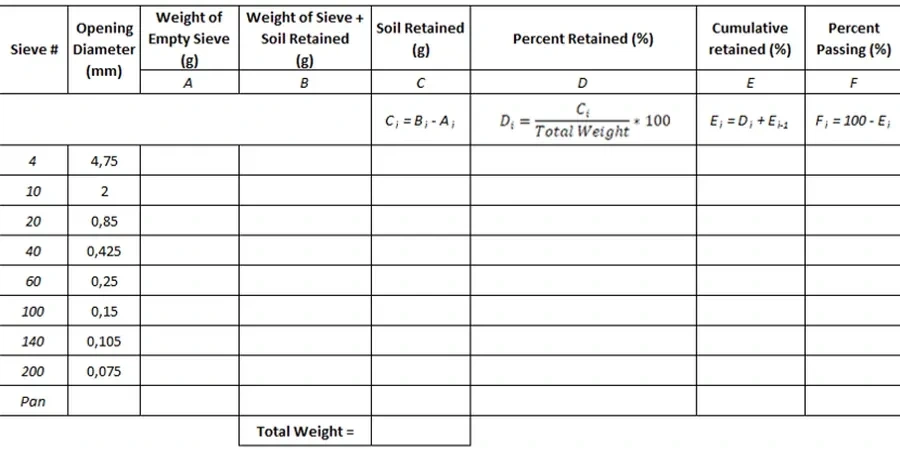
Dry sieving from 75 mm to 75 microns per AS 1289.3.6.1. Includes gradation curve, percent passing each sieve, and USCS classification.

02

Hydrometer Analysis (Fines)

Sedimentation analysis for material passing 75 microns. Measures silt and clay fractions down to 2 microns. Uses 152H hydrometer with temperature correction.

03

Combined Sieve & Hydrometer

Full particle size distribution curve. The sieve data and hydrometer data are merged at the 75-micron crossover point. D10, D30, D60 reported with Cu and Cc.

04

Filter Compatibility Assessment

Using the grain size curve to evaluate filter material suitability for drainage systems, retaining wall backfill, and erosion protection per FHWA and AS 4678 guidelines.

Standards used

AS 1289.3.6.1 (Sieve analysis), AS 1289.3.6.3 (Hydrometer analysis), AS 1726 (Geotechnical site investigations)

FAQ

How much does a grain size analysis cost in Newcastle?

Standard sieve analysis runs AU$140–AU$220 depending on sample mass and number of sieves. Combined sieve plus hydrometer ranges from AU$240–AU$320. Bulk pricing applies for five or more samples from the same project. Contact the lab with your project details for a firm quote.

How long does the hydrometer test take?

The hydrometer analysis requires a minimum of 24 hours from the start of sedimentation. Readings are taken at 0.5, 1, 2, 4, 8, 15, 30, 60, 120, 240, and 1440 minutes. Temperature control and correction are applied throughout. We report the combined curve within 48 hours of sample receipt.

What sample size do you need for sieve analysis?

Sample mass depends on maximum particle size. For material with 20 mm max size, we need about 1 kg. For 75 mm max, we require 20 kg or more. Samples must be oven-dried before sieving. We can dry them in our lab if they arrive moist — just let us know in advance.

Can you classify the soil from the grain size results?

Yes. We report the Unified Soil Classification System (USCS) symbol — GW, GP, SW, SP, SM, SC, ML, CL, etc. — based on the grain size distribution and Atterberg limits where applicable. For a full classification including plasticity, we recommend adding Atterberg limits testing to the grain size analysis.
Location and service area

We serve projects across Newcastle NSW and its metropolitan area.

View larger map
>