A seismic microzonation campaign in Newcastle starts with the equipment: a triaxial borehole geophone lowered to refusal depth, coupled with a surface hammer source striking a steel plate at precise offsets. The array feeds into a 24-channel seismograph that records shear-wave arrivals every 0.125 ms. Newcastle’s Permian coal measures and the Newcastle Earthquake of 1989—magnitude 5.6, epicentre near Boolaroo—mean the regolith overlying bedrock varies from less than 2 m on the Merewether ridge to over 30 m of alluvium in the Hunter River flats. Understanding that contrast is why microzonation matters here. The site class can shift from B to D within a single city block, and AS/NZS 1170.4 requires that differentiation before foundation design. We run the field acquisition, pick first arrivals, invert the dispersion curve, and deliver a Vs profile tied to borehole logs. For deeper bedrock mapping across larger parcels, the same crew can deploy a seismic refraction survey to image the refractor interface where the shear-wave velocity jumps above 760 m/s.
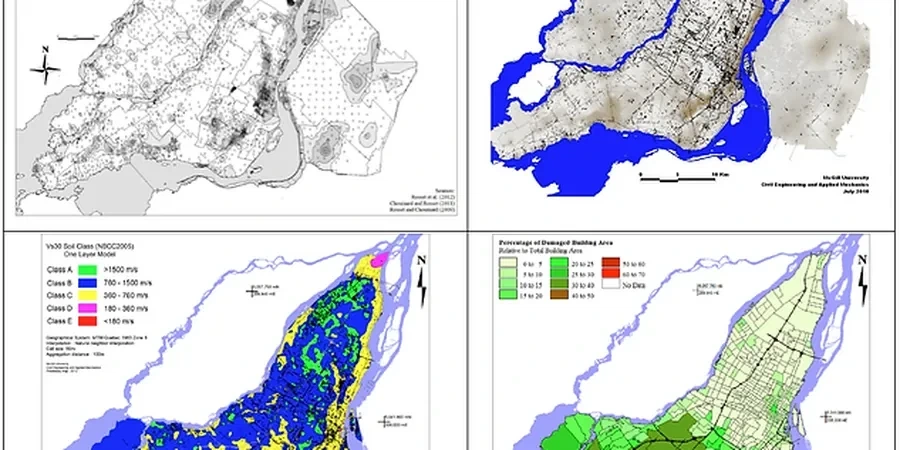
Newcastle’s shallow bedrock on the ridge and 30-metre alluvium in the river flat can place a B-class and D-class site less than 800 metres apart—standard code assumptions break down at that scale.
FAQ
What does seismic microzonation cost for a typical Newcastle industrial site?
For a medium-complexity site of 2–5 hectares in the Newcastle area, a seismic microzonation study generally falls between AU$7,170 and AU$25,420. The spread depends on the number of MASW lines, whether downhole seismic or CPT soundings are needed for liquefaction screening, and the depth to bedrock. A site on shallow Merewether sandstone requires far less fieldwork than one on deep Hunter River alluvium.
How long does a microzonation study take from field work to final report?
Field acquisition typically takes three to five days for a standard commercial site. Data processing—dispersion curve picking, inversion, and site response modelling—adds another two to three weeks. The final GIS deliverable and report are usually submitted within four weeks of mobilisation, though large linear infrastructure corridors may extend the timeline.
Is microzonation mandatory under the National Construction Code?
AS/NZS 1170.4 requires site sub-soil classification as a minimum, but a full microzonation is not explicitly mandated for every building. It becomes essential when the site straddles multiple geological units, when the consequence of failure is high, or when council conditions of consent require a site-specific hazard assessment—common in Newcastle’s CBD redevelopment and Hunter Valley infrastructure projects.