← Home · Ground improvement

Vibrocompaction Design in Newcastle NSW: Densifying Sands for Reliable Ground

Together, we solve the challenges of tomorrow.

EXPLORE →

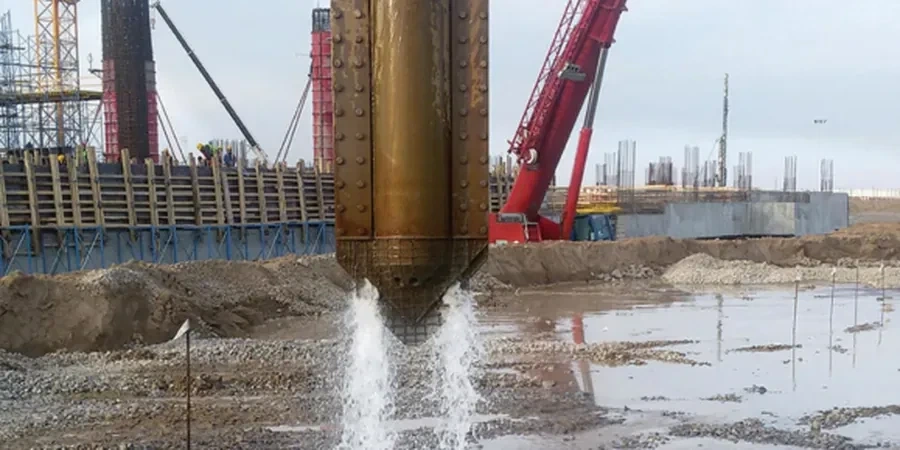
When the vibroflot lance hits the loose, saturated sands common around the Port of Newcastle and the Hunter River floodplain, you can feel the ground rearrange itself in real time. That deep, rhythmic vibration—typically from an electrically driven S3 or S5 series unit—forces sand grains into a denser packing, expelling pore water and reducing void ratios on the spot. In Newcastle, where large tracts sit on Quaternary estuarine deposits and legacy mine tailings, this isn't just about settlement control. The design has to account for the city's 5 m/s mean wind speeds off the Tasman Sea driving cyclic lateral loads into structure foundations. Getting the grid layout and energy input right from day one means the difference between a quick, clean improvement and costly rework. For projects near the Hunter Expressway or out toward Lake Macquarie, we often pair the vibro rig with a CPT test to verify densification in real time, especially where thin clay lenses can fool a standard SPT reading.

A well-designed vibrocompaction grid in Newcastle's sandy profiles can reduce post-construction settlement by over 80% compared to untreated ground.

Scope of work

Newcastle's coastal humidity and intermittent heavy rainfall events—the city averages over 1,100 mm annually—create a construction environment where moisture-sensitive sands can collapse or liquefy if not properly treated. The vibrocompaction design process here leans heavily on correlating pre-treatment fines content with achievable relative density targets. We typically aim for a minimum 70% relative density under footings, pushing toward 85% in areas mapped by the Newcastle City Council's geotechnical hazard overlays as moderate-to-high liquefaction susceptibility. The design sequence involves mapping out a triangular or square grid—often 2.5 m to 3.8 m spacing depending on the probe's influence radius—then sequencing the compaction points so that each pass benefits from the confinement built up by adjacent columns. When the site sits over historical coal workings, integrating a grouting programme with the vibro plan stabilises the overburden before any foundation load is applied.
Vibrocompaction Design in Newcastle NSW: Densifying Sands for Reliable Ground
Technical reference image — Newcastle NSW

Area-specific notes

A 14-storey mixed-use tower proposed on a former industrial lot near Wickham hit an unexpected layer of loose dredged sand at 4 metres. The initial site investigation had missed it between boreholes spaced too wide. The design team had to halt the piling submittal and rework the entire ground improvement strategy, adding a vibrocompaction phase with 2.6-metre triangular spacing to densify the layer before the raft foundation could be reconsidered. The delay cost the project six weeks. That job is a textbook reminder that Newcastle's subsurface is a patchwork: alluvial sands, coal seam gas zones, and uncompacted fill from the city's steelmaking era all sit within a few hundred metres of each other. Skipping a high-density investigation grid or relying solely on SPT data without seismic refraction to map the bedrock profile can leave you dealing with differential settlements that show up within the first wet season.

Need a geotechnical assessment?

Reply within 24h.

Email: contact@geotechnicalengineering1.co

Watch how it works

Technical parameters

ParameterTypical value
Typical probe power130–180 kW electric
Target relative density≥70% (min. under footings)
Common grid spacing2.5–3.8 m triangular
Design verification methodPre/post CPT or PMT
Applicable standardAS 4678-2002
Max treatable fines content<15% passing 75 μm
Typical treatment depthUp to 35 m (deep rigs)
Liquefaction design referenceNCEER/Youd-Idriss method

Linked services

01

Liquefaction mitigation design

We develop compaction grids and energy input profiles based on NCEER methodology to meet AS 4678 performance criteria for earthquake-prone Newcastle sites.

02

Mine subsidence zone treatment

In areas over old coal workings, we design vibro programmes that work in concert with grouting to stabilise the overburden before foundation construction begins.

03

Real-time quality control with CPT

Post-compaction cone penetration testing mapped against pre-treatment baselines to confirm that relative density targets have been achieved across the full treatment depth.

Standards used

AS 4678-2002: Earth-retaining structures, AS 1726-2017: Geotechnical site investigations, AS/NZS 1170.0:2002: Structural design actions, NCEER-97: Liquefaction resistance (Youd & Idriss)

FAQ

What does vibrocompaction design cost for a typical Newcastle residential block?

For a standard residential lot in Newcastle's sandy suburbs, vibrocompaction design fees typically fall between AU$2,210 and AU$7,630, depending on the treatment depth, grid density, and the number of verification CPT soundings required.

How deep can vibrocompaction treat loose sands in the Hunter region?

With modern electric vibroflots and extension tubes, we routinely design treatments reaching 25 to 35 metres depth. The limiting factor is usually the presence of cohesive layers, not the rig capability.

Does vibrocompaction work if the site has coal mine tailings mixed in?

It depends on the fines content. Tailings with more than 15 per cent passing the 75-micron sieve generally do not respond well to vibration alone. In those cases, we recommend supplementing or replacing vibro with stone columns or grouting.

How soon after vibrocompaction can footing construction start?

Construction can typically begin within 24 to 48 hours after the final verification CPT confirms that relative density targets have been met. No curing time is required, unlike cement-based methods.
Location and service area

We serve projects across Newcastle NSW and its metropolitan area.

View larger map