← Home · Underground Excavations

Geotechnical Design of Deep Excavations in Newcastle NSW

Together, we solve the challenges of tomorrow.

EXPLORE →

AS 4678:2002 and AS/NZS 1170 set the framework, but in Newcastle the ground dictates the design. The city sits on Permian coal measures with interbedded sandstone, siltstone, and highly variable residual soils. A desktop study won't tell you about the clay seams that daylight into a 6-metre cut on King Street. We combine site-specific test pits with targeted SPT drilling to map these discontinuities before shoring design begins. Groundwater is another constant here, perched within weathered rock zones and often underestimated on borelogs. Our designs account for hydrostatic pressure behind soldier pile walls and base heave potential where the coal seam dips toward the excavation.

In Newcastle, the biggest risk in a deep excavation is the seam you didn't know was there until the excavator bucket hits it.

Scope of work

On a recent Hunter Street project, an 11-metre bulk excavation for a mixed-use basement encountered a 600 mm clay band at 7 metres depth, right at the design toe of the shoring. The original design assumed uniform weathered sandstone. The clay was slickensided and softened rapidly on exposure. We redesigned the lower support level within 48 hours, adding a row of anchors socketed past the seam into competent rock, and specified shotcrete facing within 4 hours of each lift. The alternative was a base failure that would have compromised the adjacent heritage-listed facade. This is typical Newcastle ground: you design for what the borehole shows, then adapt to what the excavation reveals. A CPT test profile through the colluvium helped confirm the lateral extent of the weak layer without further drilling.
Geotechnical Design of Deep Excavations in Newcastle NSW
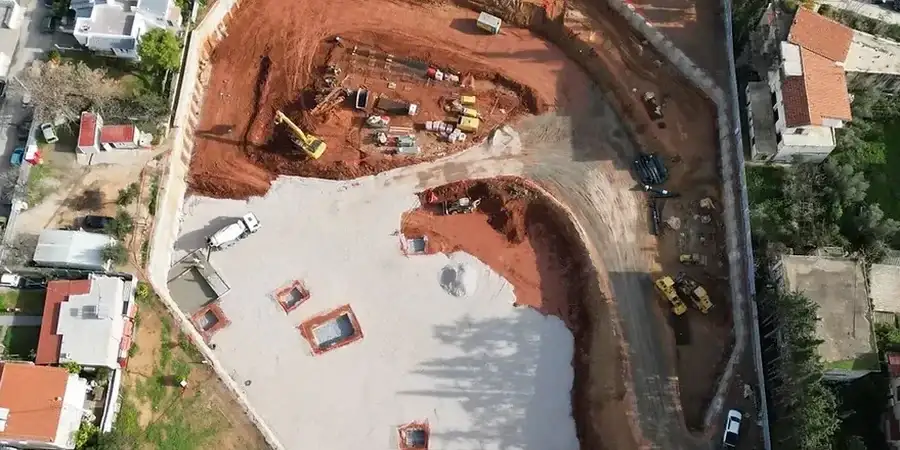
Technical reference image — Newcastle NSW

Area-specific notes

Base heave in the Newcastle CBD is a real mechanism, not a textbook exercise. The Nobbys Tuff and underlying coal seams create a confined aquifer in places. Excavate too close to the seam without depressurisation, and the base can lift overnight. We've seen basal heave of 40 mm in a 9-metre cut near the harbour when pore pressures weren't adequately relieved before bulk dig. Another local hazard is adjacent footing distress in unreinforced masonry buildings from the 1920s. Vibration from rock hammering and stress relief from unloading both contribute. Our monitoring plans specify trigger levels tighter than Table 5.1 of AS 4678: 10 mm horizontal at the property line and 5 mm vertical for heritage structures.

Need a geotechnical assessment?

Reply within 24h.

Email: contact@geotechnicalengineering1.co

Watch how it works

Technical parameters

ParameterTypical value
Design standardAS 4678:2002 Earth-retaining structures
Seismic hazard factor (Z)0.09 per AS 1170.4
Typical retaining wall typeSoldier pile with shotcrete infill
Anchor bond zone requirementRock socket min 3 m into Class II sandstone
Coal measure rock strengthUCS 5-20 MPa, highly anisotropic
Residual soil classificationCH to CI, medium to high plasticity
Groundwater managementPerimeter spear drains + sump pumping

Linked services

01

Shoring Design and Analysis

Soldier pile, secant pile, and diaphragm wall designs for cuts to 18 metres. We use WALLAP and PLAXIS 2D for bending moment, shear, and displacement prediction, calibrated to site-specific modulus values.

02

Ground Anchor Design and Testing

Prestressed rock anchors designed to AS 4678, including sacrificial corrosion allowance for the coastal environment. Proof testing to 1.25x working load, extended creep tests in weathered coal measures.

03

Construction-Phase Monitoring

Inclinometer arrays in soldier piles, vibrating wire piezometers behind walls, and optical survey prisms on adjacent structures. Weekly reporting with trigger-level compliance against agreed thresholds.

Standards used

AS 4678:2002 Earth-retaining structures, AS 1726:2017 Geotechnical site investigations, AS/NZS 1170.4:2007 Structural design actions - Earthquake actions, AS 5100.3:2017 Bridge design - Foundations and soil-supporting structures

FAQ

How much does geotechnical design for a deep excavation cost in Newcastle?

For a typical CBD basement excavation of 6 to 12 metres depth, the design package including shoring analysis, anchor design, and construction-phase monitoring plans ranges from AU$3,170 to AU$13,390. The scope depends on excavation depth, number of shoring levels, and whether groundwater modelling is required.

What are the key geotechnical challenges for deep excavations in Newcastle?

The Permian coal measures dominate: interbedded sandstone and siltstone with clay seams that soften rapidly. Groundwater is perched in weathered rock zones. Adjacent heritage masonry buildings from the early 1900s tolerate very little movement, so vibration control and settlement monitoring are critical.

How long does a shoring design take from investigation to IFC drawings?

Allow three to four weeks from receipt of the factual geotechnical report. Week one covers parameter selection and preliminary wall analysis. Week two is detailed design and anchor bond length verification. Week three produces construction drawings and specifications. Complex sites with groundwater modelling may extend to five weeks.

Do you handle the anchor testing and construction supervision as well?

Yes. We write the anchor testing specification, witness proof tests on site, and review load-extension curves against the design lock-off load. For critical anchors in weathered rock we specify extended creep tests. Construction-phase visits confirm shoring installation matches design assumptions.
Location and service area

We serve projects across Newcastle NSW and its metropolitan area.

View larger map