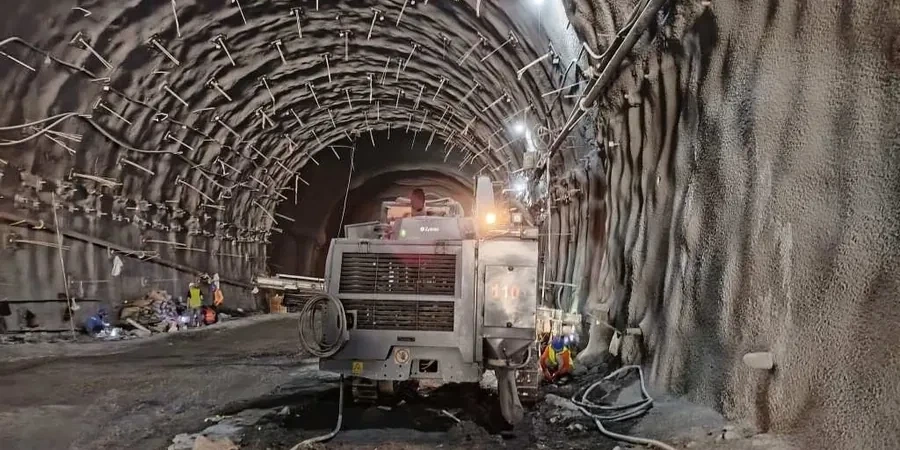
Newcastle’s transformation from a steel-making powerhouse to a modern coastal city has reshaped more than its skyline. The push into higher-density residential and commercial basements—particularly around Honeysuckle and the inner-city precinct—has driven excavation depths deeper than what was typical thirty years ago. The geotechnical reality here is complex: we’re dealing with highly variable residual soils from the Newcastle Coal Measures, perched groundwater, and weathered rock profiles that shift across short distances. Our team has monitored excavations from the Merewether escarpment down to the estuarine flats near Hexham, and we’ve learned that you can’t rely on a single design assumption. For sites where basement retention interacts with neighbouring heritage structures, pairing continuous deep excavation monitoring with targeted slope stability analysis gives us the early warning needed to adjust shoring sequences before movement becomes visible at street level.
Movement never starts at the shoring face—it starts in the soil mass behind it. Our job is to catch it there, before it becomes a defect.
FAQ
What is the typical cost range for excavation monitoring on a Newcastle townhouse site?
For a typical medium-density residential excavation in Newcastle—say a basement cut of around 4 to 6 metres with shoring on two boundaries—the monitoring package generally falls between AU$1,460 and AU$3,950. The figure depends on the number of inclinometer casings, piezometer installations, and whether automated versus manual reading cycles are specified. Higher-cost scenarios involve proximity to heritage-listed terraces or active rail corridors where third-party asset protection demands additional vibration and tilt monitoring points.
How do you set trigger values for an excavation in Newcastle's variable ground?
Trigger values aren't pulled from a generic table. We derive them from the deflection predictions in the retention design—usually a wall deflection not exceeding 0.3% to 0.5% of the excavation height for a stiff clay profile—and then tighten them further if adjacent structures have low damage tolerance. For Newcastle's residual soils over coal measures, we often set an early 'alert' threshold at about 60% of the design movement limit, which gives the contractor time to review the shoring sequence without breaching any serviceability or ultimate limit state criteria under AS 4678.
Can you monitor excavations near Newcastle's old mine workings?
Yes, and we approach those sites with a broader monitoring footprint than a standard basement job. In suburbs like Kotara or Charlestown where shallow abandoned workings are mapped, we install surface settlement arrays extending at least 1.5 times the excavation depth beyond the cut perimeter. We also grout subsurface markers into the rock at depths that span the known seam levels. This dual-layer approach lets us distinguish between deformation driven by excavation stress relief and settlement originating from mine void collapse, which is critical for assigning responsibility and triggering the right mitigation.