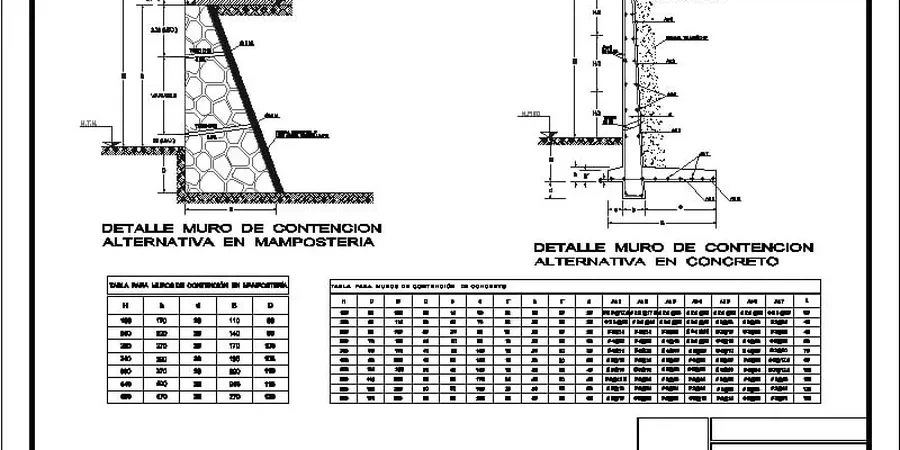
The most expensive mistake we see on Newcastle sites isn't bad concrete — it's ignoring the backfill. A wall designed to a textbook profile fails within two wet seasons when the soil behind it turns out to be Kooragang clay with a suction-driven swell pressure nobody accounted for. Newcastle's geology doesn't read textbooks. The city sits on a patchwork of Permian coal measures, alluvial floodplain deposits, and deeply weathered residual profiles that change stiffness across a single block. That's why retaining wall design here starts with a site investigation program that maps the actual soil stratigraphy, not just the assumed one. We also cross-check stiffness parameters with in-situ permeability tests because drainage dictates 80% of long-term wall performance in the Hunter's subtropical rainfall regime.
A retaining wall is only as reliable as the drainage behind it — and in Newcastle's reactive clay terrain, drainage design is a geotechnical problem, not just a structural detail.
Scope of work
On the Merewether escarpment and the slopes above Bar Beach, we repeatedly find that standard Rankine earth pressure coefficients overestimate passive resistance in partially cemented Pleistocene sands. The extra cementation — visible in hand specimens but missed by a casual visual log — gives you a Kp bump that a well-calibrated triaxial test can quantify. Our approach to retaining wall design in Newcastle layers three things: a site-specific groundwater model tied to observed perched water levels, a backfill specification that accounts for the reactive potential of locally sourced fill (common practice is to re-use site-won material, but not all of it is suitable), and a wall drainage system detailed to handle the 1-in-100-year storm event under AS/NZS 1170.2:2021. For cantilever walls on sloping sites, we also run global stability checks using limit-equilibrium software with pore-pressure profiles derived from piezometer data, not seasonal guesses.
Area-specific notes
Ignoring the Mine Subsidence Districts that overlay large parts of Newcastle's western suburbs — from Wallsend to Edgeworth — is a risk no structural designer should take. A gravity wall built over an old bord-and-pillar working can see differential settlement that opens joints, shears weepholes, and traps water behind the stem. Our team cross-references the Mine Subsidence Board's database before selecting wall type and foundation depth. The second major risk is short-term construction stability: in the deeply weathered Newcastle Coal Measures, a 3-metre cut can stand unsupported for a week in dry weather, then collapse after a single overnight storm. We specify temporary batter angles and drainage benches based on actual cohesion intercepts, not generic tables.
FAQ
What does retaining wall design cost in Newcastle?
For a typical residential or light-commercial retaining wall in the Newcastle area, the geotechnical design component generally falls between AU$1,610 and AU$6,790, depending on wall height, site access, and whether a full site investigation with laboratory testing is required.
How does AS 4678 apply to walls under 1 metre high?
AS 4678 provides guidance for all earth-retaining structures regardless of height. Even low walls require a documented stability check if they support a driveway, property boundary, or cut adjacent to a dwelling. The standard also requires consideration of surcharge loads and drainage, which are often the failure triggers in small walls.
Do I need a geotechnical investigation for a replacement wall on the same footprint?
Yes, in most cases. Newcastle's reactive soils can change drainage behaviour over time, and the original wall may have failed precisely because the ground conditions were not fully understood. A targeted investigation — often two machine-dug test pits with sampling — confirms the current soil profile and groundwater regime before redesign.