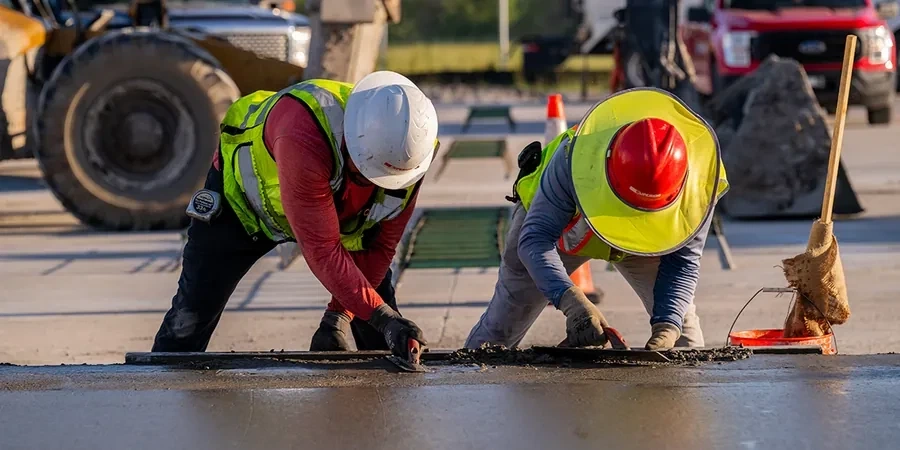
The humidity rolling in from the Tasman Sea does more than just rust the steelwork in Newcastle. It saturates the expansive clay subgrades beneath suburbs like Wallsend and Lambton, causing swell-and-shrink cycles that can crack a poorly supported concrete pavement within the first two wet seasons. And then there is the legacy of underground mining across the Hunter — voids that can open up decades after the last coal was extracted. Rigid pavement design here is not just about slab thickness; it is about reading the landscape and knowing what lies beneath. Before placing a single cubic metre of concrete, we check the subgrade reaction modulus, map the reactive soil profile, and verify the drainage conditions. For road authorities and industrial developers, pairing the concrete design with a CBR road investigation often clarifies whether the subgrade can actually deliver the assumed support over the 30-year design life.
A rigid pavement is a structural slab on a variable natural foundation — get the foundation wrong and the concrete is just expensive fill.
Scope of work
Austroads Guide to Pavement Technology Part 2 and AS 3727 set the framework, but the numbers only work if the ground model is honest. In Newcastle, we frequently encounter residual clay profiles derived from weathered Permian siltstone and sandstone — materials that hold a plasticity index above 30% and lose stiffness rapidly when wet. Our approach layers the standard laboratory suite (Atterberg limits, shrink-swell index, soaked CBR) with field plate load tests to directly measure the modulus of subgrade reaction. For heavy-duty industrial pavements at the Port of Newcastle or container terminals at Kooragang, we also model curling stresses and temperature gradients, because a 300-mm slab on a saturated clay base behaves very differently in February versus July. The concrete thickness is only one piece of the puzzle — the real engineering is in the subbase, the joints, and the long-term moisture control beneath the slab.
Area-specific notes
The 1989 Newcastle earthquake (M5.6, depth ~11 km) is a reminder that the ground here moves in more ways than one. Beyond seismicity, the dominant risk for rigid pavements is differential movement from reactive soils and mine subsidence. In suburbs built over the Borehole Seam workings — think parts of Charlestown, Kotara, and Cardiff — residual subsidence can produce ground strains that exceed the cracking limit of an unreinforced concrete slab. We quantify this through mine subsidence advisory reports and, where necessary, design articulated slabs or reinforced continuous pavements to accommodate curvature. Coastal sands near Stockton and Nobbys present a different challenge: erosion of the subbase through open joints during storm surge events. Each pavement type demands a geotechnical solution specific to the Newcastle postcode, not a generic design chart from a textbook.
FAQ
What is the typical cost range for a geotechnical investigation supporting rigid pavement design in Newcastle?
For a standard industrial or access road rigid pavement investigation in the Newcastle area, the geotechnical scope — including boreholes, plate load tests, laboratory shrink-swell and CBR testing, and a design report — typically falls between AU$3,190 and AU$9,620. The spread depends on the number of test locations, whether mine subsidence assessment is required, and the pavement length. Smaller projects with one or two plate load tests sit at the lower end; longer alignments with variable ground and mining review move toward the upper end.
How do you determine the modulus of subgrade reaction (k-value) for a rigid pavement?
We measure it directly with a static plate load test (AS 1289.6.8.1) using a 760 mm diameter plate, loading in increments and recording deflection. Where plate load testing is impractical, we correlate soaked CBR values to k using established relationships, but we always validate with at least one field test per uniform soil zone because the correlation can be off by 30% in Newcastle's structured residual clays.
What is the minimum concrete thickness for a rigid pavement on reactive clay?
There is no single minimum — it depends on the traffic loading, the design CBR or k-value, and the expected ground movement. On a highly reactive clay site (Ys > 40 mm per AS 2870), a jointed unreinforced concrete pavement might start at 200 mm for light industrial traffic and go beyond 280 mm for heavy vehicles, with the subbase thickness also increased to act as a moisture buffer. We design each pavement based on the specific subgrade conditions measured on site.
How does mine subsidence affect rigid pavement performance?
Mine subsidence in the Newcastle coalfields can induce both vertical settlement and horizontal ground strain. Rigid pavements are brittle — even 2 to 3 mm of differential movement across a joint can cause faulting or cracking. We assess the subsidence risk using Mine Subsidence Board predictions, then either design an articulated slab layout with closer joint spacing, or in more severe cases, switch to a reinforced continuous pavement that can bridge small voids. In extreme zones, Improvement through grouting may be recommended before pavement construction.
What laboratory tests do you run on the subgrade for a rigid pavement?
The core suite includes Atterberg limits (plasticity index), linear shrinkage, particle size distribution (sieve analysis), shrink-swell index to AS 1289.7.1.1, soaked California Bearing Ratio (CBR), and modified Proctor compaction. For chemically aggressive environments like the Kooragang Island industrial area, we also run pH, sulfate content, and electrical conductivity to check for concrete durability risks.