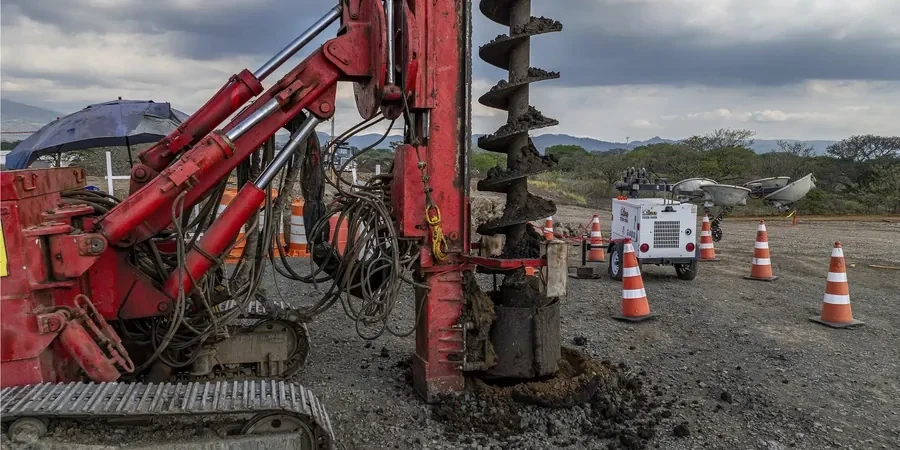
AS 4678 sets a firm benchmark for earth retaining structures, but in Newcastle the challenge often starts below the retaining level. The Hunter River floodplain and Quaternary estuarine deposits that underlie much of the CBD, Wickham, and Carrington create a compressible subsurface—soft silty clays interbedded with loose sand lenses, with SPT N-values frequently below 4 in the upper 6 metres. Stone column design here is not a generic exercise. At our Newcastle lab we couple CPT testing data with laboratory classification to define the undrained shear strength profile before selecting column diameter and spacing—because vibro-replacement in a sensitive clay with su less than 15 kPa behaves very differently from installation in a dense residual soil profile. The Port of Newcastle expansion and recent apartment developments along Honeysuckle Drive have pushed Improvement demand into zones where the water table sits barely 1.5 m below finished grade, and that demands a design approach that accounts for installation pore pressures and short-term strength loss before consolidation gain kicks in.
In Newcastle's estuarine clays, stone columns work as both bearing elements and vertical drains—design must address settlement and pore pressure dissipation simultaneously.
Scope of work
Newcastle's coastal humidity and intermittent heavy rainfall—November 2023 saw 210 mm in 48 hours at Nobbys Head—accelerate surface infiltration into already saturated alluvial profiles. This means stone column design must consider not just static bearing capacity but also drainage function. We size the columns to act as vertical drains, reducing liquefaction susceptibility in loose sand layers identified through
SPT drilling and particle size analysis. The typical Newcastle profile—1 to 3 m of fill over 8 to 15 m of soft estuarine sediment, then residual siltstone—requires columns that penetrate through the compressible layer and bear on competent material. Our designs routinely specify 600 to 900 mm diameter columns at 1.8 to 2.5 m triangular spacing, achieving an area replacement ratio between 10 and 25 percent depending on the target settlement reduction.
We also account for the aggressivity of Newcastle's groundwater, which in areas near the old BHP steelworks site carries elevated sulfate and chloride concentrations. Stone column backfill must be clean, hard, and chemically inert—typically crushed basalt or dolerite with a Los Angeles abrasion value below 30 and a sulfate soundness loss under 12 percent per AS 1141. Every design package leaves our office with a construction sequence that includes pre-drilling through crust layers, bottom-feed vibro-replacement in the soft zone, and post-installation modulus verification using plate load tests or zone load tests per AS 4678 Appendix D.
Area-specific notes
Newcastle's development history left a legacy of uncontrolled fill across former wetlands and industrial precincts. The 1989 earthquake—magnitude 5.6, centred near Boolaroo—was a wake-up call for the Hunter region. Structures on soft soil sites in Hamilton and Islington experienced amplified shaking, and post-event investigations identified liquefaction-induced settlement in loose alluvial sands. Stone column design in Newcastle now routinely incorporates a liquefaction assessment following the Seed-Idriss simplified procedure, using SPT blow counts and fines content from borehole logs. Where the factor of safety against liquefaction falls below 1.2, we densify the column spacing and extend the treatment zone to the full depth of the liquefiable layer.
Another risk we see repeatedly is differential settlement between treated and untreated zones. At sites where only part of the footprint receives stone columns—say, beneath a heavily loaded core while the perimeter remains on shallow footings—the transition zone can experience angular distortion exceeding 1/300. We model these interfaces explicitly in PLAXIS 2D, using soft soil creep parameters calibrated to oedometer tests on undisturbed Shelby tube samples from the Newcastle formation.
FAQ
How much does stone column design cost for a Newcastle site?
Design packages for stone columns on Newcastle sites typically range from AU$2,020 to AU$9,180, depending on the size of the treated area, the complexity of the soil profile, and the number of design iterations required. A straightforward residential slab on soft fill might fall at the lower end, while a multi-storey commercial project in the Honeysuckle corridor requiring liquefaction analysis and 3D modelling will be higher. Every quote includes the site investigation review, numerical modelling, and a construction specification ready for tender.
Which Newcastle soil conditions are unsuitable for stone columns?
Stone columns perform poorly in very soft clays with undrained shear strength below 12–15 kPa, where the surrounding soil cannot provide adequate lateral confinement during column installation. Peat and highly organic soils—found in some former wetland areas around Hexham and Kooragang—also pose problems because ongoing decomposition generates long-term settlement that stone columns cannot arrest. In these cases we assess alternative methods such as rigid inclusions or piled foundations through our deep foundations design service.
How does the 1989 Newcastle earthquake influence stone column design today?
The 1989 event demonstrated that loose alluvial sands in the Hunter Valley are susceptible to liquefaction under moderate shaking. Current stone column design for Newcastle sites within Seismic Site Class D or E profiles must include a liquefaction trigger analysis. Where SPT N-values corrected for overburden and energy ratio fall below critical thresholds, stone columns are designed with closer spacing to densify the sand and provide drainage, reducing excess pore pressure buildup during a future seismic event.