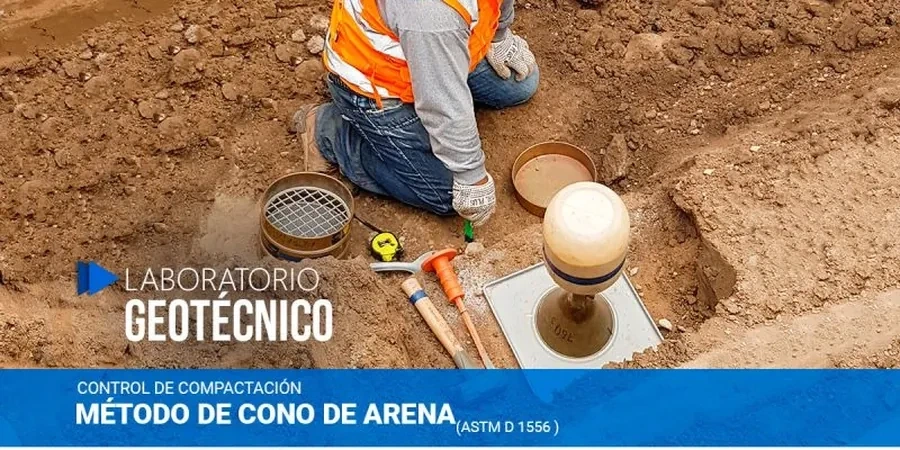
A commercial warehouse slab in Beresfield started showing hairline cracks just six months after handover. The contractor swore the fill had been properly compacted, but without a reliable field density test there was no way to prove it. That type of dispute plays out more often than it should across the Newcastle region, particularly on sites where weathered Hawkesbury sandstone transitions into residual clay. The sand cone test, specified under AS 1289.5.1.1, provides direct physical measurement of in-place wet density and dry density, removing the guesswork from compaction acceptance. On Newcastle sites with variable fill sources, the method remains the industry benchmark for quality assurance. For projects where deeper fill layers require verification, the Proctor compaction curve establishes the reference maximum dry density that field results are measured against, ensuring the laboratory standard matches site conditions.
Compaction isn't about the number of roller passes. It's about achieving the target dry density ratio, and the sand cone test is the only direct field method that gives you that number without calibration assumptions.
Area-specific notes
In Newcastle, one of the most common field problems occurs when density tests are performed on fill that has dried out after compaction. The soil passes the density requirement on the day of testing, but later swells when it reabsorbs moisture from rainfall or groundwater, causing heave in floor slabs and pavement layers. AS 3798 requires moisture conditioning within a specified range of optimum, and ignoring that requirement because the numbers look good on paper is a fast track to a failed floor. Another recurring issue involves testing on sites with uncontrolled fill containing demolition rubble or oversized rock fragments. The sand cone method loses accuracy when particles larger than 20% of the hole diameter are present, and AS 1289.5.1.1 explicitly states the maximum particle size limitations. Newcastle's undulating terrain also means compaction acceptance must account for cut-to-fill transitions, where density requirements differ between natural ground and engineered fill zones.
FAQ
How much does a field density test using the sand cone method cost in Newcastle?
Field density testing in the Newcastle region typically ranges from AU$180 to AU$250 per individual test location. The rate varies depending on the number of tests required per site visit, travel distance, and whether same-day reporting is needed. A minimum call-out fee usually applies for single-test jobs. Bulk testing programs for larger earthworks projects generally attract reduced per-test pricing.
How many sand cone tests are required on a Newcastle construction site?
AS 3798 provides the minimum testing frequency based on the area of each compacted lift. For general earthworks, at least one test per 500 m² per lift is standard. For structural fill beneath slabs or footings, the frequency increases to one test per 250 m² per lift. The supervising geotechnical engineer may adjust these numbers based on material variability, which is common in Newcastle where fill sources can change across a single site.
Can the sand cone method be used on all Newcastle soil types?
The method works well on most soils encountered in Newcastle, including residual clays, sandy silts, and decomposed sandstone, provided the maximum particle size does not exceed 20% of the excavated hole diameter. For fills containing coarse gravel or cobbles larger than about 20 mm, AS 1289.5.1.1 recommends increasing the hole diameter to 150 mm or using a replacement method such as the rubber balloon test. Our technicians assess material suitability before testing begins.
What is the difference between the sand cone test and a nuclear density gauge?
The sand cone method is a direct physical measurement: the volume of the excavated hole is determined by filling it with calibrated sand, and density is calculated from the mass of soil removed. A nuclear gauge estimates density indirectly by measuring gamma radiation backscatter or transmission. Sand cone results are generally accepted as the referee method in contract specifications under AS 1289. The trade-off is that sand cone testing takes longer per point and requires more manual excavation, but it does not require a radiation licence or special transport handling.