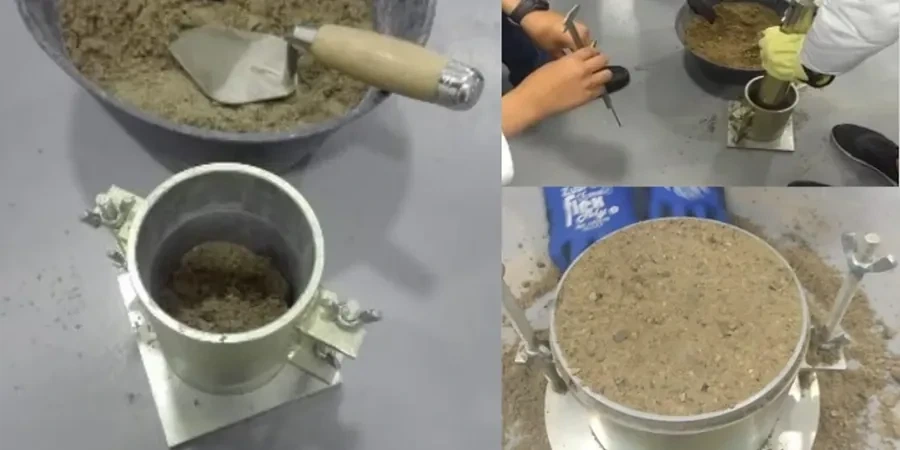
The subtropical humidity rolling in off the Tasman Sea creates a narrow window for achieving compliant compaction on Newcastle’s coastal plains and ridgelines. From the expansive claystone-derived soils of Fletcher to the sandy loams overlying the Newcastle Coal Measures in Wallsend, moisture conditioning is everything. A soil lifted at 2% above optimum can pump under a padfoot roller, while the same material compacted half a percent dry will leave a flocculated structure that settles the moment heavy rain infiltrates. Our NATA-accredited laboratory on the western fringe of the city runs both Standard and Modified Proctor tests (AS 1289.5.1.1 and AS 1289.5.2.1) to pin down the compaction curve that governs earthworks sign-off. For subdivision superintendents wrestling with reactive clay batters near the Sugarloaf Range, we often pair the Proctor with atterberg limits to predict shrink-swell behaviour before the first layer of structural fill is placed. The test itself is straightforward in principle—compacting five moisture-incremented specimens in a standard mould with a 2.5 kg or 4.9 kg rammer—but interpreting the zero-air-voids curve against a material’s specific gravity is where site-specific experience on the Permian geology of the Sydney Basin makes the difference between a passing lot and a costly rework.
A half-percent moisture deviation at the compaction layer can trigger a differential settlement claim six months after handover.
Scope of work
The compaction mould assembly we mobilise for Hunter Valley field verification is machined to AS 1289.2.1.1 tolerances: a 105 mm internal-diameter body with a detachable collar and baseplate, paired with a 50.8 mm-diameter rammer face that delivers a free-fall drop of 300 mm for Standard effort or 450 mm for Modified. The Standard Proctor applies a compactive effort of approximately 600 kN-m/m³ across three layers at 25 blows per layer, simulating the energy input of a 6-tonne smooth-drum roller making four to six passes on a 200 mm lift. The Modified Proctor ramps that up to roughly 2700 kN-m/m³—five layers at 25 blows—replicating the heavier dynamic compaction typical of mine haul roads and heavy-duty pavement subgrades around the Kooragang Island logistics precinct. When running the test on a clayey sand from a Stockton beachside development, the technician dry-sieves the material through a 19.0 mm or 37.5 mm sieve depending on oversize content, then progressively adds potable water in 1–2% increments, sealing each batch overnight to allow moisture equilibration. The entire curve, from the dry-of-optimum leg where matric suction holds the structure open to the wet-of-optimum leg where pore pressures begin to develop, is plotted with at least four points bracketing the peak so the field density technician can benchmark nuclear gauge readings against a laboratory-derived target.
Area-specific notes
Newcastle’s geological patchwork—residual clay derived from the Newcastle Coal Measures interbedded with tuffaceous sandstone and chert—means the moisture-density relationship can shift dramatically across a single cut-to-fill transition. The biggest contractual risk on a bulk-earthworks package is accepting a Proctor reference that doesn’t represent the material actually being placed. A Modified Proctor run on a dry-screened sample from the crest of a Merewether cutting will overpredict the achievable density of the wet, plastic fines that the scraper picks up from the floor of the same excavation after a summer storm. The resulting field density tests then fail against an unattainable target, triggering unnecessary re-rolling, stabilisation with lime, or—in the worst case—strip-and-replace instructions that blow the programme by three weeks. Our approach on projects exceeding 10 000 m³ of fill is to run a rolling programme of Proctor curves keyed to material-source zones, updating the reference value whenever the material type or its natural moisture content shifts visibly. For sites underlain by the Lambton Formation—notorious for its smectite-rich seams—we also recommend determining the linear shrinkage alongside the Proctor so the superintendent can anticipate the moisture sensitivity before the padfoot roller hits the fill.
FAQ
What’s the difference between Standard and Modified Proctor, and which one does my Newcastle project need?
The Standard Proctor applies roughly 600 kN-m/m³ of energy using a 2.5 kg rammer dropped 300 mm over three layers, which approximates the compaction delivered by a 6-tonne smooth-drum roller on a 200 mm loose lift. The Modified Proctor ramps that to about 2700 kN-m/m³ with a 4.9 kg rammer dropped 450 mm over five layers, simulating heavy vibratory plant or impact rollers. Residential subdivisions across Lake Macquarie and Newcastle typically reference Standard effort. Heavy-duty pavements, mine haul roads, and rail formations—common in the Hunter Economic Zone and Kooragang Island—almost always specify Modified effort. If the project’s geotechnical specification simply says “AS 3798” without nominating an effort, we ask the superintendent to confirm whether the compaction plant on site matches Standard or Modified energy before we run the curve.
How long does a Proctor test take, and how much material do you need?
A single-point Proctor determination—one moisture content compacted into the mould—can be turned around in under four hours. A full five-point compaction curve with overnight moisture equilibration typically takes one full business day from sample receipt to issued report. We need about 25 kg of representative material for a Standard Proctor and 35 kg for a Modified Proctor when oversize correction is required. The sample should be delivered in sealed plastic bags or buckets so the natural moisture content is preserved; if the material arrives oven-dry from sitting in the back of a ute all day, the curve will be shifted and the OMC will read artificially low.
What does Proctor compaction testing cost in Newcastle?
A Standard Proctor (full curve, four to five points) generally falls between AU$160 and AU$240 depending on whether oversize correction is needed. A Modified Proctor runs from AU$220 to AU$320 for the same scope. Volume discounts apply when we run a rolling programme of curves across multiple material zones on larger subdivisions; talk to the lab manager about a bulk rate if you expect more than six curves across the project.
Why did my field density test fail when the Proctor curve said the material should compact easily?
The most common culprit on Hunter sites is a mismatch between the Proctor reference material and the fill actually being placed. If the lab ran the curve on a dry-screened sample from the top of the cut but the scraper is now working wet clay from a metre lower, the reference MDD is no longer valid. Other causes include breakdown of friable sandstone particles under the roller—changing the grading and therefore the compaction curve—or using a nuclear gauge that hasn’t been correlated against a sand-cone at that specific density range. The fix is to run a new Proctor on the material as it is being placed, not as it looked during the investigation phase, and to calibrate the gauge against a direct volume measurement at least once per material type.