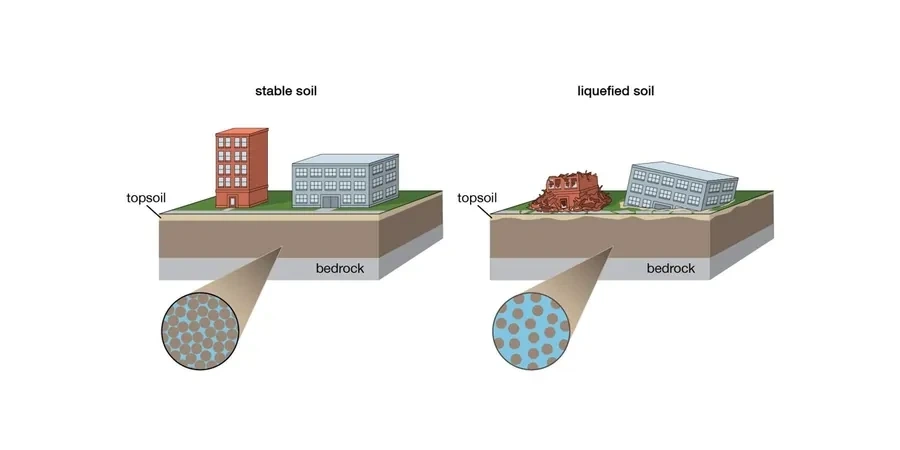
In Newcastle, the ground beneath our feet tells a story of ancient river channels, buried paleovalleys, and deep Quaternary sediments that can behave unpredictably during a seismic event. The 1989 earthquake was a stark reminder that this region is not immune to significant shaking, and since then, understanding how our local soils respond to cyclic loading has become a non-negotiable part of responsible development. When we look at a site in suburbs like Wickham or along the Hunter River floodplain, we are often dealing with loose, water-saturated sands and silts that are classic candidates for liquefaction. A proper soil liquefaction analysis goes far beyond a desktop study; it requires a targeted field investigation to measure the soil's density and resistance directly, often starting with a well-planned SPT drilling program to retrieve the disturbed samples needed for index testing and energy-corrected N-value assessment.
Liquefaction doesn't just happen in Christchurch or Kobe; the paleochannel sands beneath Newcastle can lose over 60% of their bearing capacity in a design earthquake, and the only way to know is to test them in situ.
Scope of work
A common oversight we see in local earthworks is assuming that a standard bearing capacity investigation automatically covers seismic performance. It does not. A soil can comfortably support a static load yet lose most of its shear strength within seconds of strong ground motion, turning what was solid ground into a heavy slurry. Our approach to soil liquefaction analysis in Newcastle integrates the specific requirements of AS 1726 for site characterization with the cyclic stress ratio methods refined by Seed and Idriss, which remain the global benchmark for this work. We correlate field measurements from cone penetration testing or standard penetration testing with the fines content and plasticity of the soil, determined through careful laboratory testing of the samples we recover. The Hunter Valley's variable geology, where you can move from residual siltstone to deep alluvial deposits within a single lot, demands a dense grid of investigation points to map the subsurface reliably. We often find that the critical layers for liquefaction assessment are lenses of clean sand trapped between clay strata at depths of three to seven meters, exactly the zone where many deep service trenches and basement excavations are planned. A detailed grain size distribution analysis helps us confirm whether the material is truly susceptible, and in borderline cases, we recommend site-specific cyclic triaxial testing to measure the actual pore pressure response under the design earthquake magnitude for Newcastle.
Area-specific notes
When we mobilize our drill rig to the site, typically a truck-mounted auger unit that can handle the stiff residual clays as well as the loose sands common in the Newcastle basin, the primary objective is to recover a continuous profile of the subsurface. The risk of skipping a rigorous soil liquefaction analysis is not just theoretical differential settlement; it is a cascade of structural failures that can begin with the loss of lateral support for deep foundations. In a liquefied layer, piles can buckle under axial load or shear at the interface between the liquefied and non-liquefied strata. We have observed sites near the Throsby Creek estuary where the ground surface itself can spread laterally towards the open face of a creek bank, tearing apart slab-on-ground foundations and buried utilities. For structures with basements, the sudden increase in lateral earth pressure combined with the loss of passive resistance can cause retaining walls to rotate and fail. A thorough analysis allows our engineers to quantify these risks and design Improvement solutions, such as vibrocompaction or stone columns, that densify the critical layers before construction begins, ensuring the long-term resilience of the asset in a city that has already witnessed the destructive power of an unexpected tremor.
Standards used
AS 1726:2017 – Geotechnical site investigations, AS 1170.4:2007 (R2018) – Structural design actions: Earthquake actions in Australia, AS 4678-2002 – Earth-retaining structures (seismic considerations), AS 1289 – Standard Test Method for Standard Penetration Test (SPT), NCEER/NSF (Youd et al., 2001) – Summary of liquefaction evaluation procedures
FAQ
How much does a soil liquefaction analysis cost for a residential block in Newcastle?
For a standard residential lot in Newcastle, a targeted investigation including the drilling of two to three boreholes with SPT testing at the critical depths, laboratory index testing, and the full liquefaction assessment report typically ranges between AU$4.360 and AU$6.000. The final cost depends on access conditions, the depth to the potentially liquefiable layers, and whether you require additional CPT testing for a more continuous profile.
Is a liquefaction analysis mandatory for building approval in Newcastle?
While not every single residential DA in Newcastle explicitly asks for a liquefaction report, the geotechnical investigation required by council must demonstrate that the foundation design accounts for all foreseeable hazards under the NCC and AS 1170.4. If your borehole logs encounter loose sands with a high water table, the certifier will almost always request a formal screening or a detailed soil liquefaction analysis to confirm the factor of safety exceeds the minimum required threshold.
What Improvement methods do you recommend if my Newcastle site has liquefiable soil?
The choice of mitigation depends on the depth and thickness of the problematic layer and the type of structure. For shallow liquefiable sand lenses, we often design a program of vibrocompaction or dynamic compaction to densify the soil in place. For deeper layers or where vibration is a concern near existing buildings, stone columns provide drainage and reinforcement. In some cases, it is more economical to bypass the liquefiable layer entirely with deep pile foundations socketed into the competent residual soil or rock beneath.
How do Newcastle's old buried river channels affect liquefaction risk?
Newcastle's subsurface is crisscrossed with paleovalleys filled with soft alluvium and loose channel sands that are often completely hidden by the modern topography. These buried channels can create a highly variable risk profile across a single site. Through a dense grid of CPT soundings or closely spaced SPT boreholes, we map the lateral extent of these channel sands because even a small, isolated lens of liquefiable material can cause differential settlement that damages slab-on-ground construction.