← Home · Laboratory

Triaxial Test Laboratory Newcastle NSW – Consolidated Undrained and Drained Shear Strength

Together, we solve the challenges of tomorrow.

EXPLORE →

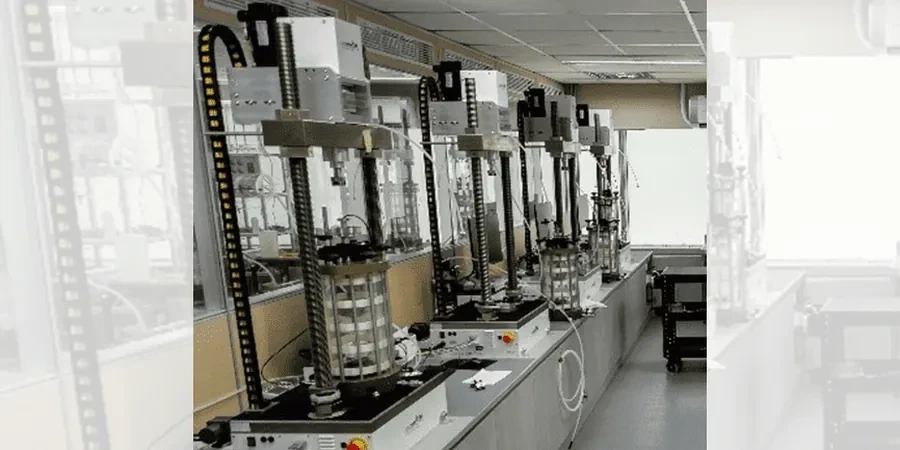
Our triaxial cell setup in Newcastle runs a Wykeham Farrance 50 kN load frame with a GDS digital pressure-volume controller — it handles back pressures up to 1 MPa, which is necessary when testing saturated estuarine silts from the Hunter River floodplain. Every specimen is trimmed to a 2:1 height-to-diameter ratio inside a temperature-controlled cabinet before saturation, consolidation, and shearing. In Newcastle, where many projects sit on residual soils derived from Permian coal measures, we often combine a test pit program with triaxial testing to recover undisturbed block samples from the weathered rock interface.

A Skempton B-value above 0.95 on Newcastle’s alluvial silts confirms full saturation before the shear phase, which is critical for undrained strength interpretation.

Scope of work

Newcastle’s post-earthquake redevelopment of the CBD after 1989 reshaped how geotechnical engineers approach high-rise foundations on the city’s slopes. The demolition of the old David Jones building on Hunter Street, for instance, exposed deeply weathered Newcastle Coal Measures that required site-specific strength parameters before any excavation could proceed. Triaxial testing provides the drained friction angle and cohesion intercept that AS 4678 demands for retaining wall design, particularly when the wall is founded on stiff clay with relic jointing. We run multi-stage CU tests with pore pressure measurement on 38 mm and 50 mm diameter specimens, targeting 95 % saturation verified through a Skempton B-value check exceeding 0.95 before the shear stage begins.
Triaxial Test Laboratory Newcastle NSW – Consolidated Undrained and Drained Shear Strength
Technical reference image — Newcastle NSW

Area-specific notes

A 10-storey mixed-use development on King Street encountered an 8-metre band of fissured silty clay that lost 40 percent of its undrained shear strength when saturated during a wet winter. The structural engineer had designed the pad footings using peak strength values from a preliminary desktop study, and the discrepancy only surfaced when we tested three Shelby tube samples in a CU triaxial configuration at confining pressures matching the foundation depth. The test results, plotted as stress paths in p'-q space, showed a contractive response and excess pore pressure build-up that pointed to a shear strength closer to the residual condition. Redesigning the footing geometry and incorporating a drainage blanket beneath the slab added three weeks to the program, but it prevented differential settlement that could have cracked the façade within two years of handover.

Need a geotechnical assessment?

Reply within 24h.

Email: contact@geotechnicalengineering1.co

Technical parameters

ParameterTypical value
Test types availableCU (consolidated undrained), CD (consolidated drained), UU (unconsolidated undrained)
Specimen diameter38 mm, 50 mm, 70 mm (undisturbed or remoulded)
Back pressure capacityUp to 1,000 kPa via GDS digital controller
Saturation verificationSkempton B-value ≥ 0.95 per AS 1726
Shear rate for CU tests0.01–0.05 mm/min, adjusted for coefficient of consolidation
Reporting standardDeviator stress vs. axial strain, excess pore pressure, Mohr-Coulomb envelope (c', φ')
Sample preparationTrimmed in humidity-controlled room, wax-sealed field samples accepted

Linked services

01

Consolidated Undrained Triaxial with Pore Pressure Measurement

CU triaxial tests on saturated cohesive soils from Newcastle boreholes, with electronic pore pressure transducer logging throughout the shear stage. We report total and effective stress Mohr-Coulomb parameters (c, φ, c', φ') for slope stability and foundation bearing capacity analyses.

02

Consolidated Drained Triaxial and Strength Envelope Determination

CD triaxial tests on sands and stiff clays at strain rates slow enough to dissipate excess pore pressure. Three specimens are sheared at different effective confining stresses to define the drained failure envelope, suitable for long-term retaining wall design and cut slope assessments.

Standards used

AS 1726:2017 – Geotechnical site investigations, AS 4678:2002 – Earth-retaining structures, AS 1289.6.4.1 – Method for triaxial compression tests (consolidated undrained), AS 1289.6.4.2 – Method for triaxial compression tests (consolidated drained)

FAQ

What is the typical cost of a triaxial test program in Newcastle?

A standard set of three CU triaxial tests with pore pressure measurement on 50 mm specimens typically ranges from AU$2,610 to AU$4,170, depending on the number of consolidation stages, required confining pressures, and whether specimens need to be extruded from Shelby tubes in our lab. Multi-stage tests and drained (CD) programs fall at the higher end of the range due to the extended shear phase.

How long does a CU triaxial test take from sample receipt to report?

A consolidated undrained triaxial test set usually requires 7 to 10 working days. Saturation can take 24 to 48 hours for low-permeability Newcastle clays, consolidation another 24 hours per stage, and the shear phase at 0.02 mm/min adds roughly 6 to 8 hours per specimen. Drained tests take longer because the strain rate must be slow enough to maintain zero excess pore pressure.

Which Newcastle soil types benefit most from triaxial testing?

Triaxial testing is essential for the fissured clays of the Newcastle Coal Measures and the soft estuarine silts along Throsby Creek and the Hunter River. These materials often exhibit strength anisotropy that cannot be captured by unconfined compression or pocket penetrometer readings alone. The CU test with pore pressure measurement gives engineers the effective stress parameters needed for reliable foundation and retaining wall design.
Location and service area

We serve projects across Newcastle NSW and its metropolitan area.

View larger map